A deep dive into the HCM pedestrian methodology for signalized intersections
The objective of this article is to provide clarifications and as the result to simplify the use of
🛣 📗 HCM 7th edition,
🚦 🚗 Chapter 19 Signalized Intersections,
🚶 🚶 Section 5 Pedestrian Methodology
🚨
The reason for writing this article is that there are several titles and subscripts throughout the section that do not seem to play any actual role in the methodology and have caused different interpretations of the methodology among the practitioners. This article summarizes these points and so helps to have a more clear idea of the HCM pedestrian methodology of signalized intersections.
There are “major” and “minor” titles and subscripts throughout the section, including in exhibit 19-29. They are used for referring to the major and minor flow signal phases. However, there seems to be no real difference between the calculations of major and minor street pedestrians. In other words, the calculations for major and minor legs are the same and the HCM only instructs the analyst to change the subscripts in order to apply the methodology to different legs (bottom of page 19-78, middle of page 19-82, bottom of page 19-83). Signal phases that are referred to, are either the associated phase or the thru phase of the crossing flow (that is in another barrier).
Additionally, on page 19-79 the crosswalk that is being analyzed is named “D” and so the set of equations from 19-56 to 19-60 all have the subscript “D”. Then the analyst is instructed to change the D to C (bottom of page 19-78) in order to run this calculation for crosswalk C. In other words, D or C actually refers to any subject crosswalk.
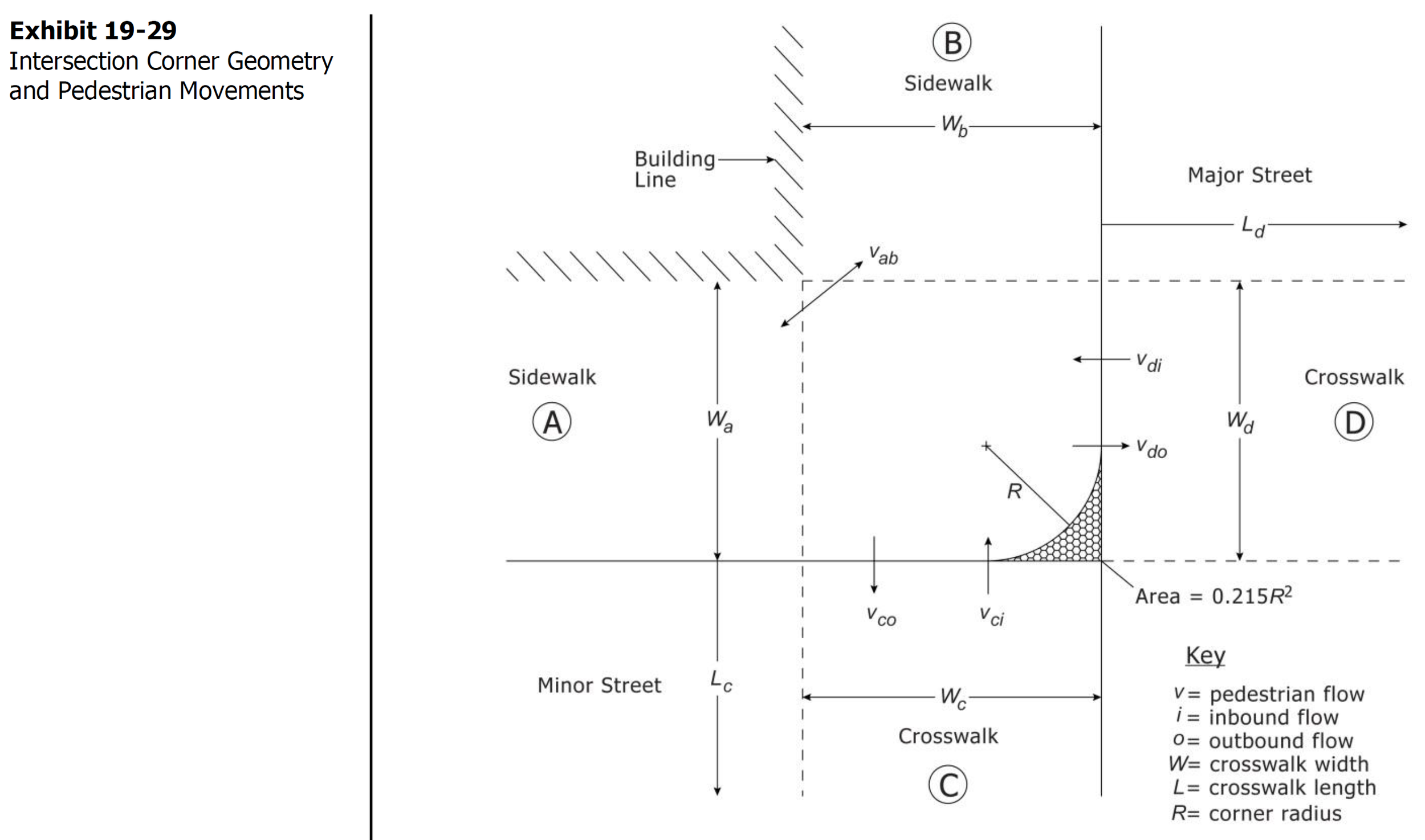
These titles and subscripts have caused different interpretations of the methodology among practitioners ⚠ ; especially where the titles of major and minor are clearly used in the definition of the equation parameters that do not have any major or minor subscripts (equations 19-62 & 63 | 19-66 | 19-71, 72 & 73 | 19-74 & 75). This can be interpreted as "regardless of the position with respect to subject crosswalk, the major or minor flow parameter should be used" which does not seem to be right based on the other information.
Due to different interpretations, the software developers have implemented the methodology differently ⚠ . Some developers have implemented their own understanding of the methodology and others have implemented the exact methodology with the major and minor definitions/titles.
🚨 This calls for a clarification on this section 💡.
Just to add, the only use of “Inbound” and “Outbound” pedestrian titles is in the two optional steps 4 (page 19-80) and 5 (page 19-83), which are separate from determining the LOS. These titles will be changed for studying each corner. In other words, depending on the corner, the same pedestrians will be considered as Outbound or Inbound which adds to the complexity.
In step 4 (the quality of movement of pedestrians using each corner), Outbound pedestrians of each corner are used separately in equations 19-62 and 19-63 to calculate a concept of capacity that they occupy from the corner while waiting to cross (either of the two crosswalks of the corner) and so to deduct it from the available capacity for circulation. The total of pedestrians using the corner is used in equation 19-56 and their required circulation measure (based on a concept of capacity) is compared with the remaining circulation. Also in this step, the sidewalks of each corner (for example between crosswalk D and C) are named as sidewalks A and B which is only used in calculating the available waiting area through the term Wa x Wb in equation 19-61.
In step 5 (the quality of movement of pedestrians using each crosswalk) required time for the pedestrians walking in each direction is calculated and then is multiplied by their volume. Then the results of the two directions are summed up and the total is compared with the available capacity.
